


Digital business cards: a complete guide for professionals and companies [2026].
Imagine you arrive at a trade show, you are introduced to a key contact and... you have no cards. Or worse: you do, but there's a mistake in the contact details. With a digital business card, that problem disappears forever. Your professional information travels with you on your mobile, always up to date and ready to share with a single touch.
In this guide you will discover what exactly a digital business card is, how it works, what advantages it offers over paper cards and how to choose the right platform to create it, whether you are a freelancer or you need to manage the cards of an entire team.
What is a digital business card
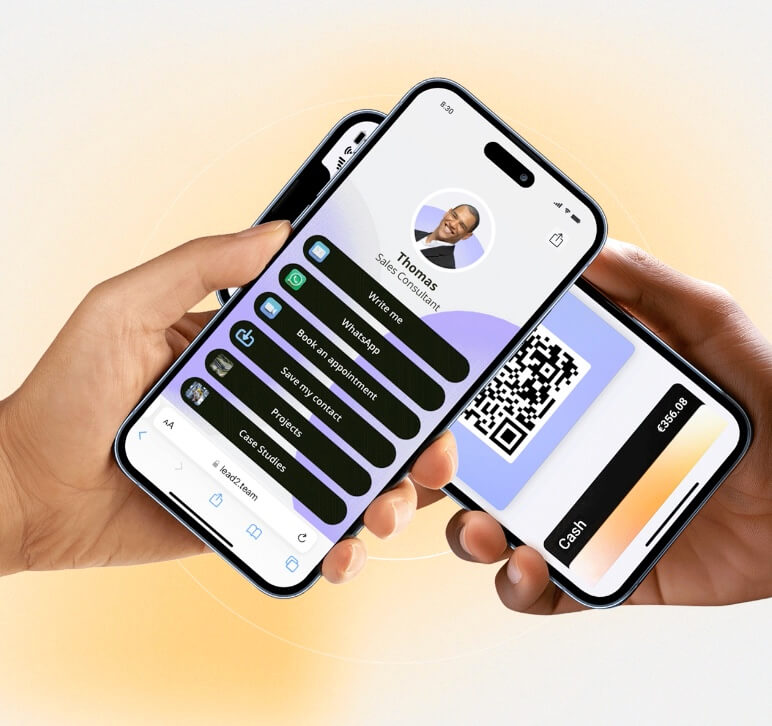
A digital business card is a online professional profile which contains your contact information, links to social networks, professional resources and any relevant data you want to share. It works as a personal web page accessed via a link, a QR code, from Apple or Google Wallet, or through your email signature.
Unlike a paper card, the digital card is updated in real time. If you change your job title, phone number or company, you only have to change your profile once and everyone who has your link will see the updated version automatically.
You do not need to install any app to use it or to receive it: everything works from the browser of the cell phone or computer.
Difference between Digital Card, NFC Card and Paper Card
It is common to confuse these three concepts. Here are the key differences:
| Feature | Paper card | Digital card | NFC card |
|---|---|---|---|
| Format | Physical (cardboard/paper) | Software (web profile) | Physical (plastic/wooden/metal with chip) |
| Update | To be reprinted | Snapshot from the panel | Updates automatically (links to digital card) |
| Ways to share | In hand | Link, QR, Wallet, email signature, social networks | Zooming to mobile + backup QR |
| Information | Limited to physical space | Unlimited: links, videos, catalogs, networks, etc. | Same as digital card (redirects to profile) |
| Cost per person | Recurring (each reprint) | Digital Subscription | One-time purchase + digital subscription |
| Sustainability | High paper consumption | No waste | One card replaces hundreds of pieces of paper |
| Need app | No | No | No |
The NFC card is a physical support which is engraved with the URL of your digital card. When someone approaches your cell phone, it automatically opens your profile. It is a complement, not a substitute for the digital card.
In this article we focus on the digital cardThe professional profile that you can share in multiple ways without the need of any physical support.
What information is included in a digital business card
A well configured digital business card can include:
- Basic dataname, position, company, professional photo
- Direct contact: phone, email, WhatsApp (one touch to start a call or message)
- Social networksLinkedIn, Instagram, Twitter/X, Facebook, TikTok, YouTube
- Professional links: website, portfolio, meeting calendar (Calendly or others)
- ResourcesPDF catalogs, corporate videos, presentations, etc.
- Location: link to Google Maps with office address
- Save contact button: the recipient downloads your vCard directly to his address book
The advantage is that you are not limited to the space of a piece of cardboard. You can include everything that is relevant to your professional activity, organized in a clear and interactive way.
Why you need a digital business card in 2026
The transformation of professional networking
Networking has changed radically in recent years. Hybrid work, virtual events, videoconference meetings and the internationalization of teams have made exchanging a paper card less and less practical.
According to industry data, the global digital business card market has grown by 15% annually since 2022 and is expected to exceed $300 million by 2027. In Spain, adoption is accelerating, especially in the industrial, food, technology, automotive, real estate and insurance sectors.
The reason is simple: Professional networking now happens both in person and digitally. You need a tool that works in both environments.
Key advantages over traditional cards
- Always with youYour card is in your cell phone. You don't forget it, you don't run out.
- Always up to dateYou change one piece of information and it is updated for everyone. Without reprinting anything.
- InteractiveOne touch to call, send email or open WhatsApp. No need to type numbers.
- More information: links to websites, networks, catalogs, videos, meeting schedules...
- MeasurableYou know how many times your card has been viewed and which links generate the most interest.
- Sustainablezero paper, zero waste. One digital card replaces thousands of printouts.
- ProfessionalThe image of you and your company is modern and technologically up to date.
If you want to go deeper into the comparison between digital and paper cards, We will tell you about it in detail in another article.
Who uses digital business cards: professional profiles
Digital business cards are not only for technology companies. These are the profiles that get the most out of them:
- Commercial teamsThey attend several trade fairs during the year, and increasingly avoid carrying paper cards.
- Managers and C-levelExecutive image with integrated meeting agenda.
- Freelancers and freelancers: portfolio, networks and contact in a single link.
- Real EstateEach agent with its own card, property catalog and direct WhatsApp.
- Consultantsprofiles by area of expertise.
- Startupssmall teams with very different profiles.
- Any professional networking: events, congresses, trainings, meetings.
How a digital business card works
The operation is simpler than it seems. In four steps you already have your card operational.
Create your professional digital profile
It all starts with the creation of your profile. You access a platform such as Lead2Team, enter your basic data (name, position, company, email) and in seconds you have the basis of your digital card ready.
If you also add your website, Lead2Team's artificial intelligence scanner will automatically extract the most relevant information: your company logo, corporate colors and your main links. No extra work on your part.
And don't forget the photo: add a professional image, as it's the first thing anyone who visits your card will see.
Customize design and content
Once the profile is created, you will also be able to set up the connectorsInteractive buttons that bring your card to life (call, send email, open LinkedIn, download catalog...).
The recommendation is to include between 5 and 10 connectors. The direct action ones (phone, email, WhatsApp) go first, and the informative resources (web, catalog, video) at the end.
Sharing: link, QR, Wallet and email signature
Your digital card can be share in various ways:
- Customized linkA unique URL that you can paste into any message, email or social network.
- QR CodeDownload it in PNG, JPG or SVG and use it in presentations, trade show booths, flyers or even on your actual paper card. More about this in our guide to QR codes for business cards.
- Apple Wallet and Google Wallet: you carry your card in the Wallet of your cell phone and share it with a tap. It even works offline.
- Email signatureA QR image with your QR that is inserted in the signature footer of Gmail, Outlook or any email client. Every email you send becomes an opportunity to share your card. Find out how to set up your email signature with QR.
What the person receiving your card sees
The receiver does not need to install any app. He simply opens the link in his browser and sees your complete profile: photo, contact details, interactive buttons and a «Save contact» which downloads your information directly to your address book.
Some digital cards (such as Lead2Team's digital card) include in contact form so that the recipient can also leave you their data: name, email and phone number. You receive them instantly as a new lead in your email inbox.
It is a two-way exchange that benefits both parties.
What to look for in a digital card platform
Not all digital card platforms offer the same thing. Here are the key criteria to make the right choice:
Personalization and corporate branding
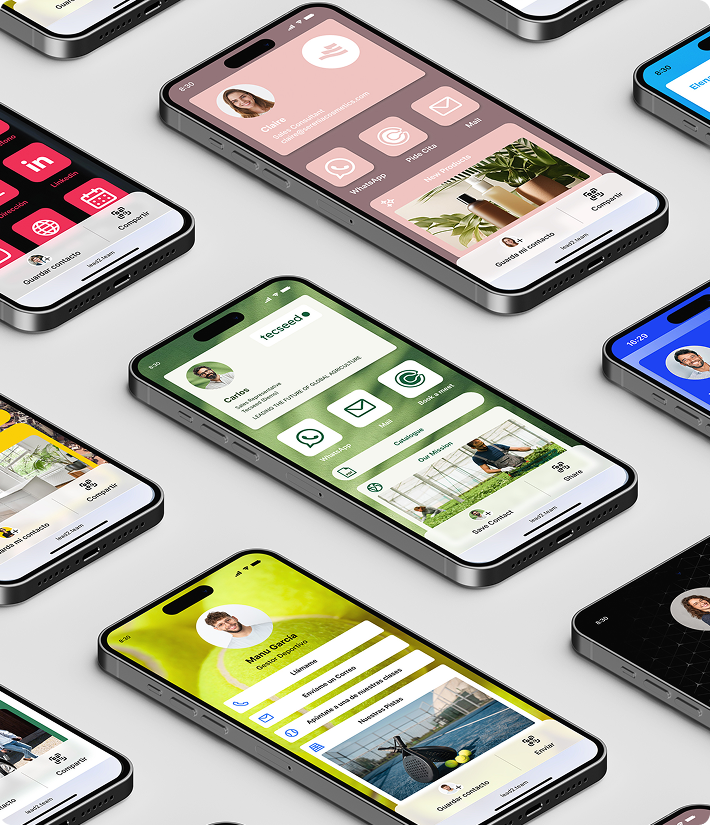
Your card should reflect your company's identity: colors, logo, typography. Look for a platform that allows create several layouts (e.g. one for management and one for the sales team) and assign them per person.
In Lead2Team, you can create multiple customized designs and assign them from an Excel-like view, which makes it easier to manage when you have tens or hundreds of cards.
Sharing options: beyond QR
A QR code is fine, but it's not enough. Make sure the platform offers at least:
- Personalized link with own domain
- QR code downloadable in various formats (PNG, JPG, SVG)
- Compatibility with Apple Wallet and Google Wallet
- Email signature with integrated QR
The more ways to share, the more networking opportunities.
Team and employee management
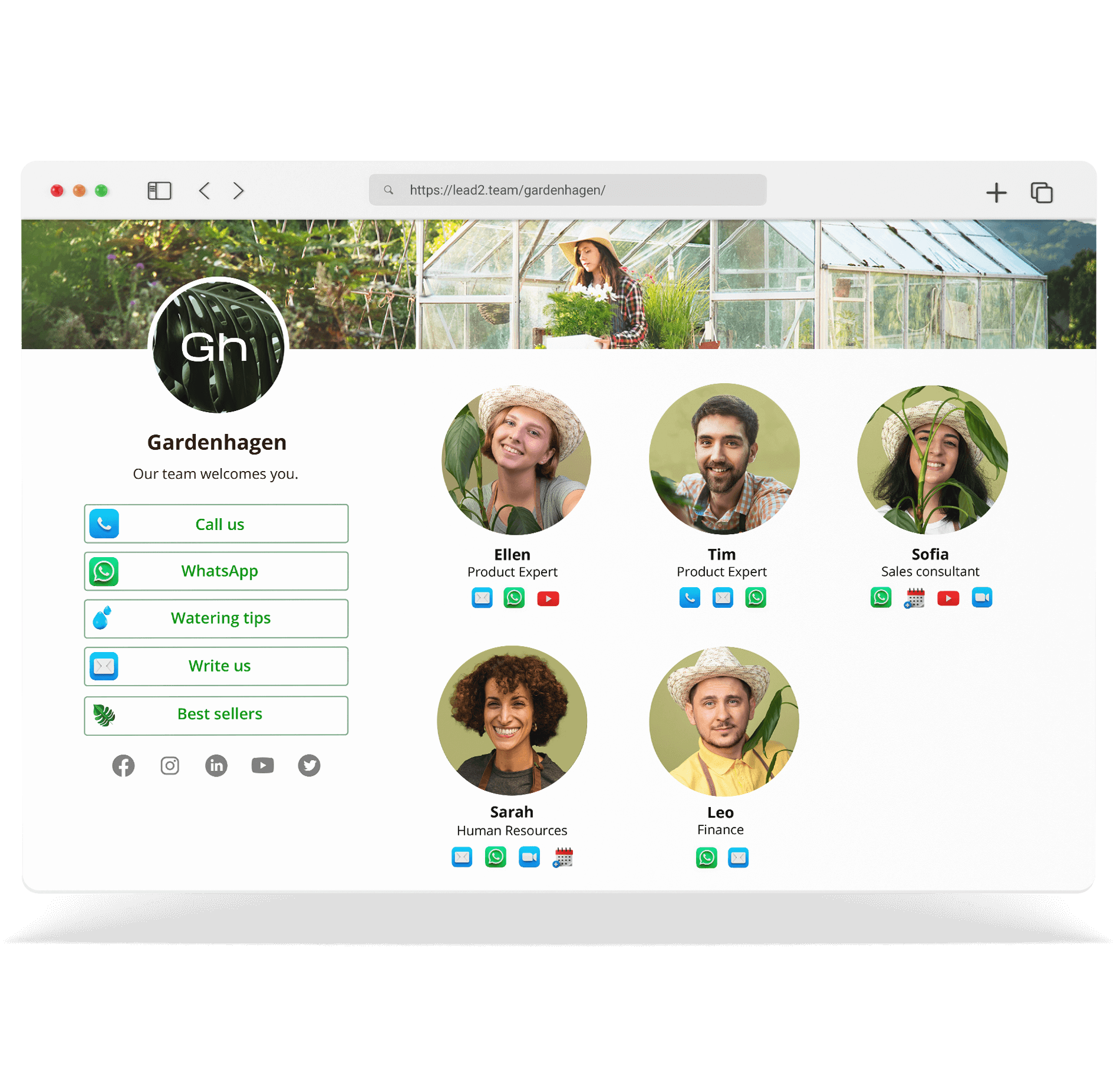
If you are going to create cards for a team, you need management tools: mass card creation (import from Excel), reusable templates, mass editing, assigning designs by department and sending automatic onboarding emails.
Lead2Team stands out in particular here with its Free Team Manager, which unlocks an Excel view to manage all the cards in the team as if it were a spreadsheet, and a system of templates with dynamic variables that automatically personalizes each card.
Contact analytics and metrics
A good platform tells you how many times each card has been viewed, which buttons generate the most clicks and how many leads have been collected. This data is gold to know what works and what needs to be improved.
In addition, every time someone fills out the contact form on your card, you receive an email notification with all their details. You can respond in the heat of the moment, when interest is fresh.
Integrations with enterprise tools
Check that the platform integrates with your ecosystem: CRM (via Zapier or Make), Google Analytics 4 to measure card performance, and the ability to embed cards in your corporate website.
Digital business cards for companies: corporate use
Benefits for the company
Implementing digital business cards at the corporate level is not just a matter of image. It has concrete operational advantages:
- Brand consistencyall cards follow the same visual line, with no outdated versions circulating.
- Centralized updatinga change in the template is propagated to all cards instantly.
- Printing savingsEliminates the recurring cost of designing and printing paper cards every time someone changes positions, phone numbers or departments.
- Lead acquisitionEach card is a contact collection point with an integrated form.
- Fast onboardingNew employees receive their digital card by email, ready to use, without waiting weeks for printed cards to arrive.
Implementation and deployment for equipment
The typical process to deploy digital cards in a company is:
- Activate equipment management (in Lead2Team, the Team Manager is activated for free in one click).
- Create the cardsThe following options are available: manually, by duplicating existing profiles or by importing from an Excel/CSV file.
- Configure the templates: define common connectors per department (email, phone, WhatsApp, web, catalog...) with dynamic variables that are customized per person.
- Customize the designCorporate colors, logo, typography. Different designs can be created per department or brand.
- Send the onboarding emailEach employee receives an email with their card, instructions, Wallet download and email signature. All ready to use.
Everything is managed from a single panel, with no technical knowledge required.
Use cases by department
| Department | Typical connectors | Approach |
|---|---|---|
| Address | Email, LinkedIn, web, meeting agenda, press release | Executive Networking |
| Commercial | Phone, WhatsApp, email, LinkedIn, catalog PDF, demo, video | Direct sales and lead generation |
| Marketing | Email, LinkedIn, agenda, web, social networks | Relationships and positioning |
| Support | Email support, central phone, LinkedIn, web | Customer service |
| HR | Email, LinkedIn, job portal, interview schedule | Employer branding |
The interesting thing is that each department can have its own connector template and its own design, all centrally managed.
How to create your digital business card step by step
The process is quick and requires no technical knowledge. Here is the summary:
- Choose the platformYou are looking for one that offers customization, multiple ways to share and team management.
- Create your account and profileName, position, company, email and professional photo.
- Add your connectors: phone, email, WhatsApp, LinkedIn, web, catalog, whatever you need.
- Customize the designcolors, logo, typography. That reflects your brand.
- Configure the ways to share: link, QR, Wallet, email signature.
- Share and start networking.
If you want a detailed tutorial with each step, you will find it in our guide. how to create your digital business card step by step.
With Lead2Team, this whole process takes less than 5 minutes. And you can try it for free.
Ways to share your digital business card
One of the great advantages of the digital card over the paper one is the versatility to share it. You don't have to carry it with you physically: it is always available on your cell phone.
The main forms of sharing are:
- Customized linkCopy and paste it into WhatsApp, LinkedIn, email, SMS or any platform. The URL generates an automatic preview in most apps.
- QR CodePrint it on your booth, presentations, flyers, paper cards or event badges. Download it at PNG, JPG or SVG.
- Apple Wallet and Google Wallet: always carry your card in your cell phone and share the QR with a tap, even offline.
- Email signature: add a image with your QR in the signature footer and turn every email into a networking opportunity.
- Social networksshare the link in your Instagram bio, LinkedIn posts or direct messages.
To learn more about each method and its best practices, please consult our complete guide on how to share your digital business card.
Frequently asked questions about digital business cards
What is a digital business card and how does it work?
A digital business card is an online professional profile with your contact information, social networks and relevant links. It is shared via link, QR code, Wallet or email signature. The recipient opens it in their browser (no app required) and can save your contact directly to their address book.
How much does a digital business card cost?
It depends on the platform and plan. In Lead2Team, you can try it for free for 7 days. Annual subscription plans are available for any number of cards, and monthly plans are offered starting from 5 cards. The cost is significantly lower than printing paper cards on a recurring basis.
How to share a digital business card?
You have at least five ways: copying and pasting the personalized link, displaying the QR code, from Apple or Google Wallet, through the email signature or sharing the link on social networks and messaging.
Do you need an app to use a digital business card?
No. Neither you nor the receiver need to install any application. The card is managed from the browser and the receiver sees it directly in his browser when he opens the link.
Is a digital card better than a paper card?
In most contexts, yes. The digital card is more versatile (it is shared through multiple channels), is always up to date, allows more information to be included (links, videos, catalogs), is measurable and does not generate waste. Here is a detailed comparison.
Can I customize my digital business card with my company colors?
Of course. Professional platforms like Lead2Team allow you to customize colors, logo, typography and even create several different designs for different departments or brands within the same company.
What information is included in a digital business card?
Everything you need: name, position, company, photo, phone, email, WhatsApp, social networks, website, PDF catalog, corporate video, link to meeting calendar, location on Google Maps and a button to save the contact in the address book.
Do digital cards work without internet connection?
The card itself needs a connection to be displayed in the browser. However, if you have it added to Apple Wallet or Google Wallet, you can display your QR code offline. The other person scans the QR and, when connected, accesses your full profile.